Part I – Carbon Dioxide Scrubber Filter Damage
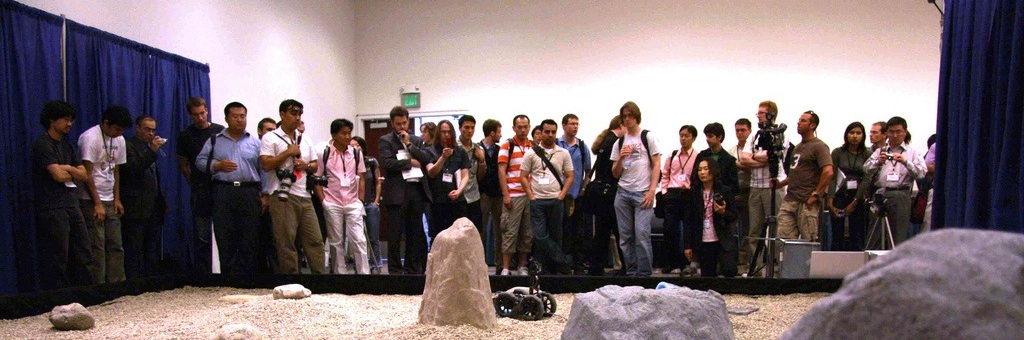
Scenario: Your lunar space station has passed through a micro-meteor storm that has damaged your external CO2 scrubber system. The endcap on the CO2 venting tube running between the station and the scrubber filter has failed and has fallen off. In addition the CO2 filter has suffered several cracks. You must find a way to seal the end of the CO2 venting tube and seal the cracks in the scrubber filter. You must use a special glue to seal the CO2 vent. You have five hours of oxygen left.
Details: The scrubber has a pressure activated door for emergencies to keep valuable air from venting into space. This door may be used to access the inside of the tube, though air escapes while it is open. The venting tube has a 90 degree bend in it. There is a pressure sensor that emits a green light and protrudes ~1.5″ from the ceiling inside the tube. Space station external camera is working. The scrubber filter gets very hot and requires a special adhesive to patch cracks.
Rules: Scrubber airlock can only be open for 5 seconds then it should be closed for at least 5 minutes. Scrubber endcap is sealed when no green light can be seen from the outside. You are limited to 10 minutes per run. You may remain on the field past 10 minutes if no one is waiting. Only one robot is allowed in the vent and one outside at the same time. If your robot gets stuck, you may request a referee (Jimmy, Matt, Mike or Mark) to get the robot for you and bring it back. You may not go past the screen.
Scoring:
- Sealing scrubber exhaust 3 pts for 50%, 5 pts for 75%, 10 pts for 95%, 15 pts for 100%
- 10 points for each scrubber filter crack sealed
- 10 points for retrieving failed cap
Part II – Solar Panel Failure
Scenario: You are on Mars. A martian storm has damaged your base’s solar generators. Luckily your battery power will last for five hours before the Martian cold and darkness kills everyone. You must retrieve the damaged solar panel, bring it back to base, fix it (just touch it), and redeploy. There is a space station camera that gives you a view of the outside of the space station. However it is broken. There is another team working on fixing it, but it won’t be ready until 12:00 noon.
Rules: You may use a tether, but you may not touch it while the robot is deployed. When you are ready to attempt a run, you must bring your robot to one of the tables in front of the screen. Your robot must go through the airlock. Place your robot in the airlock. Mike will open the doors, you may then drive out. You are limited to 10 minutes per run. You may remain on the field past 10 minutes if no one is waiting. We will allow two robots on the field at the same time. You must not interfere with each other. If a third person arrives, and both teams have been on the field past 10 minutes, the first person on the field must leave. If your robot gets stuck, you may request a referee (Jimmy, Matt, Mike or Mark) to get the robot for you and bring it back. You may not go past the screen.
Scoring:
- 10 points for bringing the damaged solar panel back to base
- 10 points for placing a new panel
- 10 points for attaching one wire, 10 points for attaching second wire
- 10 points for adding second panel (extra credit)
Results:
- First Place – Morpheus (University of Southern California)
- Second Place – Diamond (MIT)
- Third Place – SOSLab (University of Washington)
- Fastest Prototyping Team – Cornell University
- Most Persistent – Diamond (MIT)
- Coolest Robot – ODIN (University of Southern Denmark)
- Most Innovative – SOSLab (University of Washington)
Publication
-
![[DOI]](https://www.modlabupenn.org/wp-content/plugins/papercite/img/external.png) M. Yim, “Planetary contingency [education],” Robotics automation magazine, ieee, vol. 15, iss. 4, pp. 14-16, 2008.
M. Yim, “Planetary contingency [education],” Robotics automation magazine, ieee, vol. 15, iss. 4, pp. 14-16, 2008.
[Bibtex]@ARTICLE{MY:08, author={Yim, M.}, journal={Robotics Automation Magazine, IEEE}, title={Planetary contingency [Education]}, year={2008}, volume={15}, number={4}, pages={14-16}, keywords={Collaborative work;Discrete event simulation;Educational robots;Hardware;Orbital robotics;Robotic assembly;Robotics and automation;Software tools;Space technology;Vents}, doi={10.1109/MRA.2008.930405}, ISSN={1070-9932},}